


Estiloreiwa
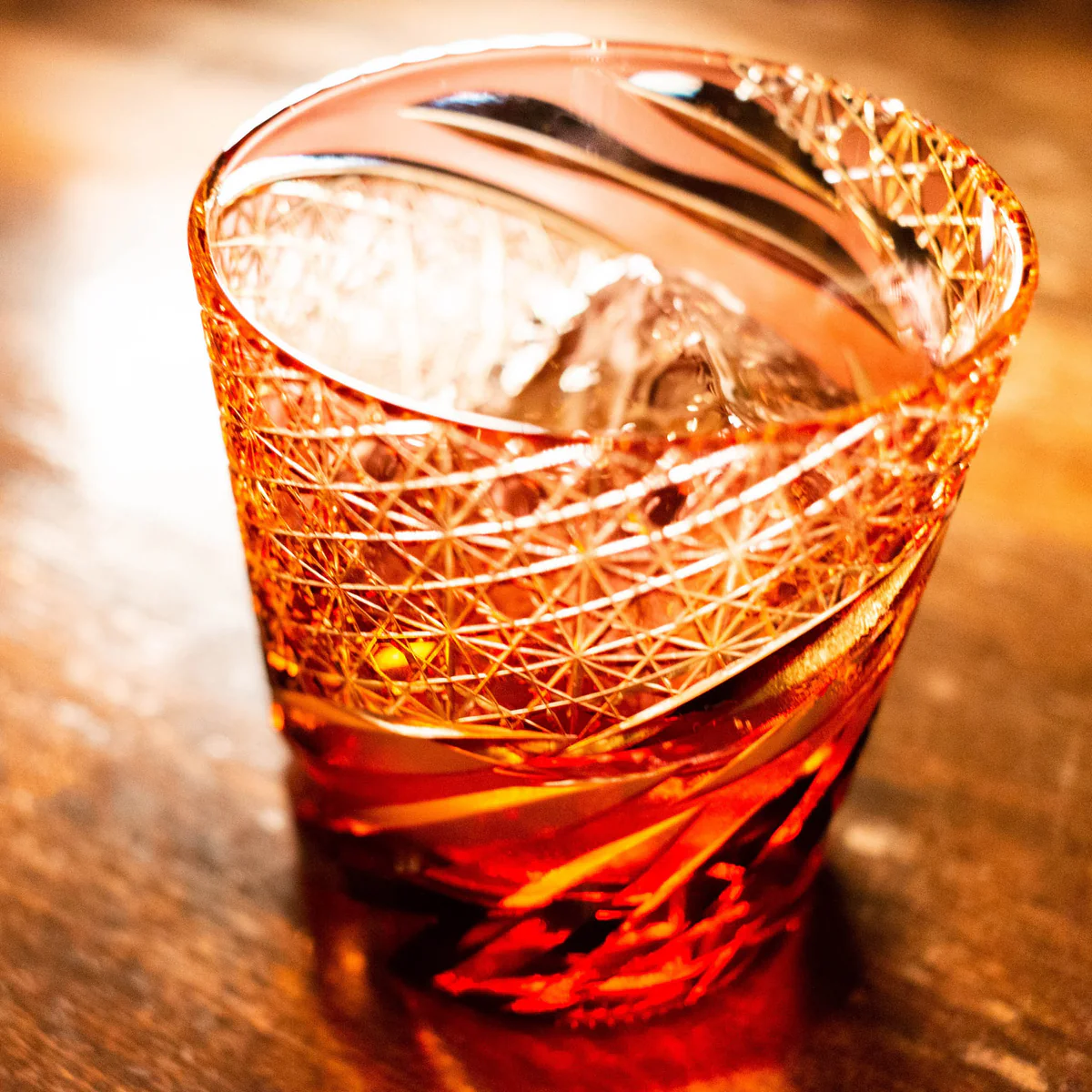
Old Fashioned Glass-Otaru Kiriko/Miabi/Amber Red-Gold(Kinaka)/Fukagawa Glasss Craft
Old Fashioned Glass-Otaru Kiriko/Miabi/Amber Red-Gold(Kinaka)/Fukagawa Glasss Craft
Couldn't load pickup availability
A glass with bold and passionate cuts that change its impression depending on the angle
While many associate “kiriko” with Edo or Satsuma styles, Otaru Kiriko—originating from Otaru—offers something completely different.
Its key feature is the use of dual-colored glass, where a vibrant outer layer is fused over amber glass. To bring out the contrast, artisans polish the edges by hand, allowing the amber glow to shine through.
After cutting, a fire polish technique is used to add a brilliant luster—showcasing both skill and beauty unique to Otaru Kiriko.
The “Miyabi (雅)” design introduced Otaru Kiriko to the world. Bold cuts combine with traditional chrysanthemum patterns, and the amber base gives the impression of a burning flame.
Irregular cuts mean every angle reveals a different charm—making each glass a one-of-a-kind experience.
This old-fashioned glass is heavy and solid, ideal for relaxing moments while admiring its luminous brilliance.
Each one dazzles with such brilliance that it's hard to look away.
Fukagawa Glass Craft
Masters of light and fire, deeply devoted to Otaru Kiriko
Originally founded in Tokyo’s Fukagawa district, Fukagawa Glassworks earned acclaim by supplying top-tier colored glass to Edo Kiriko artisans.
In 2003, they relocated to Otaru, Hokkaidō, building large-scale facilities where they began developing unique cuts and products—only possible because they manufacture their own base glass.
They studied Edo Kiriko techniques while evolving their own. The result: Otaru Kiriko—captivating in both brilliance and precision.
They also uphold the Sustainable Development Goals (SDGs) through recycled glass, meltwater systems, and heat-reuse technologies—drawing attention even abroad.
-
Place of origin: Otaru City, Hokkaidō
-
Size: Diameter 8.3 cm × Height 9 cm
-
Weight: 340 g
-
Capacity: 290 ml (full)
Materials
Materials
Crystal glass
Box: Paulownia wood box (kiribako)
Shipping & Returns
Shipping & Returns
Dimensions
Dimensions
- Size: Diameter 6 cm × Height 5 cm
- Weight: 150 g
- Capacity: 80 ml (full)
Care Instructions
Care Instructions
- Not heat-resistant or reinforced glass.
- Handle with care as the glass may break.
- Avoid sudden temperature changes or impact.
- Do not use in microwave ovens, dishwashers, dish dryers, or over direct flame.
- To clean dirty cuts, use materials softer than the glass, such as toothbrushes or soft sponges.
- As handmade glass vessels are used, there may be slight variations in thickness, color, or inscriptions between pieces.



Founded in 1960
The workshop of a master craftsman fascinated by transparency and light
Toa Glass Craft was established in 1960 as an Edo Kiriko workshop. Initially, it specialized in industrial glass cutting, such as whisky bottles, and trained over 200 artisans. Later, the focus shifted to producing Edo Kiriko. Today, the workshop is led by a father—recognized as a “Tokyo Meister” by the Tokyo Metropolitan Government—and his son, a certified traditional craft artisan. Together, they manage made-to-order projects, custom orders, and original design work.
What sets artisan Satoshi Nabetani apart is his emphasis on “transparency and light.” He uses vessels with layered translucent colored glass, and designs pieces in which a large part of the top layer is removed to expose the clear glass beneath—reflecting his philosophy that “the charm of Edo Kiriko lies in the light.”
His dedication to selecting vessels that enhance transparency and light results in an Edo Kiriko that continues to reveal new expressions depending on how the light strikes it.